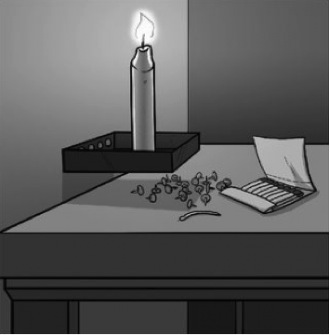
Using the materials below, how could you fix the candle to the wall so that when lit the candle does not drip on the table?

This experiment was created by Karl Duncker in 1945. A picture of the answer can be seen at the end of this post.
The experiment is testing a heuristic called “functional fixedness”. When you originally see the box holding the tacks, the only job we envision for the box is to hold the tacks. We must overcome our fixation on that function, to envision an alternate use for the box: tacked to the wall to catch the wax from the candle.
In the 1960’s Sam Glucksberg (Princeton University) adapted the candle test to test the impact of a reward for solving the problem quickly. The control group was not incentivized with a reward. The trial group was told they would be given $5 if they were in the top 25% fastest solvers, $20 if they were the fastest solver. The incentivized trial group took 3.5 minutes longer than the control group that had no reward. The financial reward somehow blocked the trial group from solving the candle test as quickly. It’s almost as if part of your brain is fixated on the money, instead of being focused on solving the problem.
Presuming this result transcends into different industries, the impact of rewards on human learning and creativity is significant. If extrinsic rewards stifle creative problem-solving, how can we avoid them? In schools we tie performance to grades, scholarships, rankings, entrance to choice post-secondary programs. If our institutions are systemically designed to reward performance, and rewards undermine creative performance, what can we do?
A solution in education is to go “gradeless”. Gradeless classrooms focus on learning against standards or mastery-based assessments rather than traditional letter or percent grades. Some schools, such as the Hawken School in Cleveland, are phasing out the traditional grading system for digital portfolios. This is a great example of the system systemically shifting, to allow room for more diverse assessment practices. This is trickier, but not impossible, to do in schools that use a traditional grading system. One strategy is to check off successfully completed outcomes, and leave outcomes not met blank, and then convert this into a percentage for the reporting period. If the candle test results hold true for education, identifying systems with functional fixedness and phasing them out will lead to more creative problem-solving.

 Jessica DesRoches